Ink-based disposable electrodes: Versatile analytical platforms for point-of-need applications
DOI:
https://doi.org/10.62063/rev-28Keywords:
Conductive inks, disposable electrodes, inkjet printing, point-of-need, screen-printing, electrochemical sensorsAbstract
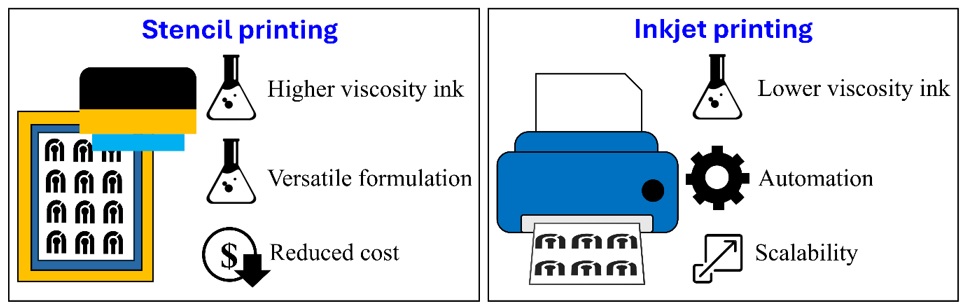
Ink-based disposable electrodes are emerging as promising technologies in analytical chemistry, driven by the increasing demand for on-site analysis in medical, food, and environmental sectors. Their widespread adoption is attributed to their low cost and easy fabrication. Additionally, such devices can provide fast and reliable results, making them valuable analytical tools for unprivileged communities and remote areas. This review focuses specifically on the fabrication of disposable electrodes using ink-based techniques, including stencil/screen printing and inkjet printing. It begins with an overview of ink formulation, highlighting the role of raw materials and the importance of their control in electrode fabrication processing. Subsequently, the principles, advantages, and limitations of each printing technique are discussed, demonstrating the potential and versatility of the resulting sensors in diverse analytical applications. Therefore, this work provides comprehensive insights into the fabrication of ink-based electrodes, aiming not only to consolidate the state of the art but also to encourage new approaches and technological advances in the development of accessible, versatile, and effective electrochemical sensors.
References
Adkins, J., Boehle, K., & Henry, C. (2015). Electrochemical paper-based microfluidic devices. Electrophoresis, 36(16), 1811–1824. https://doi.org/10.1002/elps.201500084 DOI: https://doi.org/10.1002/elps.201500084
Akiiga, N. S., Rashad Fath El-Bab, A. M., Yoshihisa, M., & El-Moneim, A. A. (2025). Enzyme-Free glucose detection in sweat using 2D inkjet-printed cobalt sulfide anchored on graphene in a paper-based microfluidic device. Journal of colloid and interface science, 688, 490–504. https://doi.org/10.1016/j.jcis.2025.02.129 DOI: https://doi.org/10.1016/j.jcis.2025.02.129
Akindoyo, J. O., Ismail, N. H., & Mariatti, M. (2021). Development of environmentally friendly inkjet printable carbon nanotube‐based conductive ink for flexible sensors: effects of concentration and functionalization. Journal of materials science: Materials in electronics, 32(9), 12648–12660. https://doi.org/10.1007/s10854-021-05900-y DOI: https://doi.org/10.1007/s10854-021-05900-y
Aliyeva, P., Yilmaz, B., Uzunarslan, D. A., & Enisoglu Atalay, V. (2025). Identification of new candidate molecules against SARS-CoV-2 through docking studies. The European chemistry and biotechnology journal, 4, 14–23. https://doi.org/10.62063/ecb-40 DOI: https://doi.org/10.62063/ecb-40
Anushka, B.A., & Das, P. K. (2023). Paper based microfluidic devices: a review of fabrication techniques and applications. European physical journal: Special topics, 232(6), 781–815. https://doi.org/10.1140/epjs/s11734-022-00727-y DOI: https://doi.org/10.1140/epjs/s11734-022-00727-y
Araújo, D. A. G., Oliveira, A. C. M., Pradela-Filho, L. A., Takeuchi, R. M., & Santos, A. L. (2021). A novel miniaturized electroanalytical device integrated with gas extraction for the voltammetric determination of sulfite in beverages. Analytica chimica acta, 1185, 339067. https://doi.org/10.1016/j.aca.2021.339067 DOI: https://doi.org/10.1016/j.aca.2021.339067
Asif, I. M., Giulio, T. Di, Gagliani, F., Mazzotta, E., & Malitesta, C. (2025). Advances in the Direct Nanoscale Integration of Molecularly Imprinted Polymers ( MIPs ) with Transducers for the Development of High-Performance Nanosensors. Biosensors, 15(8), 509. https://doi.org/10.3390/bios15080509 DOI: https://doi.org/10.3390/bios15080509
Ataide, V. N., Mendes, L. F., Gama, L. I. L. M., R.Araujo, W., & Paixão, T. R. L. C. (2020). Electrochemical paper-based analytical devices: ten years of development. Analytical methods, 12(8), 1030–1054. https://doi.org/10.1039/c9ay02350j DOI: https://doi.org/10.1039/C9AY02350J
Ataide, V. N., Pradela-Filho, L. A., Ameku, W. A., Negahdary, M., Oliveira, T. G., Santos, B. G., Paixão, T. R. L. C., & Angnes, L. (2023). Paper-based electrochemical biosensors for the diagnosis of viral diseases. Microchimica acta, 190(7). https://doi.org/10.1007/s00604-023-05856-2 DOI: https://doi.org/10.1007/s00604-023-05856-2
Barich, H., Voet, O., Sleegers, N., Schram, J., Felipe Montiel, N., Beltran, V., Nuyts, G., & De Wael, K. (2024). Selecting optimal carbon inks for fabricating high-performance screen-printed electrodes for diverse electroanalytical applications. Journal of electroanalytical chemistry, 971, 118585. https://doi.org/10.1016/j.jelechem.2024.118585 DOI: https://doi.org/10.1016/j.jelechem.2024.118585
Berkel, C., & Özbek, O. (2024). Green Electrochemical Sensors, Their Applications and Greenness Metrics Used: A Review. Electroanalysis, 36(11), 1–16. https://doi.org/10.1002/elan.202400286 DOI: https://doi.org/10.1002/elan.202400286
Bi, S., Dong, W., Lan, B., Zhao, H., Hou, L., Zhu, L., Xu, Y., & Lu, Y. (2019). Flexible carbonic pen ink/carbon fiber paper composites for multifunctional switch-type sensors. Composites part A: Applied science and manufacturing, 124, 105452. https://doi.org/10.1016/j.compositesa.2019.05.020 DOI: https://doi.org/10.1016/j.compositesa.2019.05.020
Bi, S., Hai, W., Wang, L., Xu, K., Chen, Q., Chen, C., Yu, Q., Chen, C., Li, M., Shao, H., Shao, G., Jiang, J., & Chen, N. (2023). Green One-Step Strategy of Conductive Ink for Active Health Monitoring in Rehabilitation and Early Care. ACS applied materials and interfaces, 15, 57593−57601. https://doi.org/10.1021/acsami.3c12851 DOI: https://doi.org/10.1021/acsami.3c12851
Boček, Ž., Zubak, M., & Kassal, P. (2025). Fully Inkjet-Printed Flexible Graphene–Prussian Blue Platform for Electrochemical Biosensing. Biosensors, 15(1), 7–11. https://doi.org/10.3390/bios15010028 DOI: https://doi.org/10.3390/bios15010028
Boumegnane, A., Nadi, A., Cochrane, C., Boussu, F., Cherkaoui, O., & Tahiri, M. (2022). Formulation of conductive inks printable on textiles for electronic applications: a review. Textile progress, 54(2), 103–200. https://doi.org/10.1080/00405167.2021.2094135 DOI: https://doi.org/10.1080/00405167.2021.2094135
Bouzidi, K., Chaussy, D., Gandini, A., Flahaut, E., Bongiovanni, R., & Beneventi, D. (2022). Bio-based formulation of an electrically conductive ink with high potential for additive manufacturing by direct ink writing. Composites science and technology, 230(P1), 109765. https://doi.org/10.1016/j.compscitech.2022.109765 DOI: https://doi.org/10.1016/j.compscitech.2022.109765
Bucciarelli, A., Olivetti, E., Adami, A., & Lorenzelli, L. (2021). Design of Experiment Rational Optimization of an Inkjet Deposition of Silver on Kapton. IEEE sensors journal, 21(23), 26304–26310. https://doi.org/10.1109/JSEN.2021.3058543 DOI: https://doi.org/10.1109/JSEN.2021.3058543
Cagnani, G. R., Ibáñez-Redín, G., Tirich, B., Gonçalves, D., Balogh, D. T., & Oliveira, O. N. (2020). Fully-printed electrochemical sensors made with flexible screen-printed electrodes modified by roll-to-roll slot-die coating. Biosensors and bioelectronics, 165, 112428. https://doi.org/10.1016/j.bios.2020.112428 DOI: https://doi.org/10.1016/j.bios.2020.112428
Calvert, P. (2001). Inkjet printing for materials and devices. Chemistry of materials, 13(10), 3299–3305. https://doi.org/10.1021/cm0101632 DOI: https://doi.org/10.1021/cm0101632
Camargo, J. R., Orzari, L. O., Araújo, D. A. G., de Oliveira, P. R., Kalinke, C., Rocha, D. P., Luiz dos Santos, A., Takeuchi, R. M., Munoz, R. A. A., Bonacin, J. A., & Janegitz, B. C. (2021). Development of conductive inks for electrochemical sensors and biosensors. Microchemical journal, 164. https://doi.org/10.1016/j.microc.2021.105998 DOI: https://doi.org/10.1016/j.microc.2021.105998
Camargo, J. R., Orzari, L. O., de Souza Rodrigues, J., Felipe de Lima, L., Longo Cesar Paixão, T. R., Fraceto, L. F., & Janegitz, B. C. (2024). Advancements in disposable electrochemical systems for sustainable agriculture monitoring: Trends, gaps, and applied examples. TrAC - Trends in analytical chemistry, 180, 117968. https://doi.org/10.1016/j.trac.2024.117968 DOI: https://doi.org/10.1016/j.trac.2024.117968
Camargo, J.R., Crapnell, R. D., Bernalte, E., Janegitz, B. C., & Banks, C. E. (2025). Water-Based Conductive Ink for the Production of Carbon Black Screen-Printed Electrodes and the Detection of Tryptophan. ACS applied electronic materials, 7(12), 5599–5610. https://doi.org/10.1021/acsaelm.5c00550 DOI: https://doi.org/10.1021/acsaelm.5c00550
Campos-Arias, L., Peřinka, N., Lau, Y. C., Castro, N., Pereira, N., Correia, V. M. G., Costa, P., Vilas-Vilela, J. L., & Lanceros-Mendez, S. (2024). Improving Definition of Screen-Printed Functional Materials for Sensing Application. ACS applied electronic materials, 6(4), 2152–2160. https://doi.org/10.1021/acsaelm.3c01415 DOI: https://doi.org/10.1021/acsaelm.3c01415
Cardoso, R. M., Castro, S. V. F., Silva, M. N. T., Lima, A. P., Santana, M. H. P., Nossol, E., Silva, R. A. B., Richter, E. M., Paixão, T. R. L. C., & Muñoz, R. A. A. (2019). 3D-printed flexible device combining sampling and detection of explosives. Sensors and actuators, B: Chemical, 292, 308–313. https://doi.org/10.1016/j.snb.2019.04.126 DOI: https://doi.org/10.1016/j.snb.2019.04.126
Carvalho, J. H. S., Stefano, J. S., Brazaca, L. C., & Janegitz, B. C. (2023). New conductive ink based on carbon nanotubes and glass varnish for the construction of a disposable electrochemical sensor. Journal of electroanalytical chemistry, 937, 117428. https://doi.org/10.1016/j.jelechem.2023.117428 DOI: https://doi.org/10.1016/j.jelechem.2023.117428
Ceylan, E., Gurbuz, H. N., Kotan, H., & Uzunoglu, A. (2025). Inkjet-printed flexible electrochemical sensors based on palladium and silver-decorated, N-doped holey graphene and nano graphene. Microchemical journal, 209, 112682. https://doi.org/10.1016/j.microc.2025.112682 DOI: https://doi.org/10.1016/j.microc.2025.112682
Coltro, W. K. T., & Janegitz, B. C. (2025). Screen-Printing vs Additive Manufacturing Approaches: Recent Aspects and Trends Involving the Fabrication of Electrochemical Sensors. Analytical chemistry, 97, 1482–1494. https://doi.org/10.1021/acs.analchem.4c05786 DOI: https://doi.org/10.1021/acs.analchem.4c05786
Costa, N. G., Buga, C. S., Homem, N. C., Paleo, A. J., Sencadas, V., Viana, J. C., Gonzales, A., Antunes, J. C., & Rocha, A. M. (2025). Screen-printed textile substrates’ suitability as a platform for electrochemical sensors’ construction. Journal of electroanalytical chemistry, 976, 118805. https://doi.org/10.1016/j.jelechem.2024.118805 DOI: https://doi.org/10.1016/j.jelechem.2024.118805
Crapnell, R. D., & Banks, C. E. (2024). Electroanalytical Overview: Screen-Printed Electrochemical Sensing Platforms. ChemElectroChem, 11(19), 1–22. https://doi.org/10.1002/celc.202400370 DOI: https://doi.org/10.1002/celc.202400370
da Silva, G. O., de Araujo, W. R., & Paixão, T. R. L. C. (2018). Portable and low-cost colorimetric office paper-based device for phenacetin detection in seized cocaine samples. Talanta, 176, 674–678. https://doi.org/10.1016/j.talanta.2017.08.082 DOI: https://doi.org/10.1016/j.talanta.2017.08.082
Dai, Y., Chiu, L. Y., Sui, Y., Dai, Q., Penumutchu, S., Jain, N., Dai, L., Zorman, C. A., Tolbert, B. S., Sankaran, R. M., & Liu, C. C. (2019). Nanoparticle based simple electrochemical biosensor platform for profiling of protein-nucleic acid interactions. Talanta, 195, 46–54. https://doi.org/10.1016/j.talanta.2018.11.021 DOI: https://doi.org/10.1016/j.talanta.2018.11.021
de Freitas, R. C., Camargo, J. R., Brazaca, L. C., Angnes, L., Fatibello-Filho, O., & Janegitz, B. C. (2026). Eco-friendly screen-printed sensor using tapioca-based conductive ink modified with coconut fibers. Talanta, 298, 128875. https://doi.org/10.1016/j.talanta.2025.128875 DOI: https://doi.org/10.1016/j.talanta.2025.128875
de Freitas, R. C., Fonseca, W. T., Azzi, D. C., Raymundo-Pereira, P. A., Oliveira, O. N., & Janegitz, B. C. (2023). Flexible electrochemical sensor printed with conductive ink made with craft glue and graphite to detect drug and neurotransmitter. Microchemical journal, 191, 108823. https://doi.org/10.1016/j.microc.2023.108823 DOI: https://doi.org/10.1016/j.microc.2023.108823
de Lima, L. F., Corsato, P. C. R., Beluomini, M. A., Ferreira, A. L., Esterdos Santos, L., Barbosa, P. P., Simeoni, C. L., de Jesus, M. B., Proenca-Modena, J. L., Paixão, T. R. L. C., & de Araujo, W. R. (2025). Smart Textile Electrochemical Capacitive Biosensor for Real-Time Monkeypox Virus Detection. ACS applied electronic materials, 7(7), 2882–2893. https://doi.org/10.1021/acsaelm.5c00055 DOI: https://doi.org/10.1021/acsaelm.5c00055
de Matos Morawski, F., Martins, G., Ramos, M. K., Zarbin, A. J. G., Blanes, L., Bergamini, M. F., & Marcolino-Junior, L. H. (2023). A versatile 3D printed multi-electrode cell for determination of three COVID-19 biomarkers. Analytica chimica acta, 1258, 341169. https://doi.org/10.1016/j.aca.2023.341169 DOI: https://doi.org/10.1016/j.aca.2023.341169
Deroco, P. B., Junior, D. W., & Kubota, L. T. (2021). Silver inkjet-printed electrode on paper for electrochemical sensing of paraquat. Chemosensors, 9(4). https://doi.org/10.3390/chemosensors9040061 DOI: https://doi.org/10.3390/chemosensors9040061
Dungchai, W., Chailapakul, O., & Henry, C. S. (2009). Electrochemical detection for paper-based microfluidics. Analytical chemistry, 81(14), 5821–5826. https://doi.org/10.1021/ac9007573 DOI: https://doi.org/10.1021/ac9007573
Facure, M. H. M., Braunger, M. L., Mercante, L. A., Paterno, L. G., Riul, A., & Correa, D. S. (2022). Electrical Impedance-Based Electronic Tongues. In Encyclopedia of Sensors and Biosensors, First Edition, Four Volume Set (Vol. 3). Elsevier. https://doi.org/10.1016/B978-0-12-822548-6.00091-1 DOI: https://doi.org/10.1016/B978-0-12-822548-6.00091-1
Fernandes, I. J., Aroche, A. F., Schuck, A., Lamberty, P., Peter, C. R., Hasenkamp, W., & Rocha, T. L. A. C. (2020). Silver nanoparticle conductive inks: synthesis, characterization, and fabrication of inkjet-printed flexible electrodes. Scientific reports, 10(1), 1–11. https://doi.org/10.1038/s41598-020-65698-3 DOI: https://doi.org/10.1038/s41598-020-65698-3
Ferreira, B., Arantes, I. V. S., Gongoni, J. L. M., Pradela-Filho, L. A., & Paixão, T. R. L. C. (2024). Stencil-printed graphene electrodes for affordable electrochemical sensing of capsaicin. Microchemical journal, 207, 112197. https://doi.org/10.1016/j.microc.2024.112197 DOI: https://doi.org/10.1016/j.microc.2024.112197
Gomez-Gijon, S., Ortiz-Gómez, I., & Rivadeneyra, A. (2025). Paper-Based Electronics: Toward Sustainable Electronics. Advanced sustainable systems, 9(1), 1–25. https://doi.org/10.1002/adsu.202400486 DOI: https://doi.org/10.1002/adsu.202400486
Gopalakrishnan, S., Mall, D., Pushpavanam, S., & Karmakar, R. (2025). Rapid antimicrobial susceptibility testing using carbon screen printed electrodes in a microfluidic device. Scientific reports, 15(1), 1–12. https://doi.org/10.1038/s41598-024-84286-3 DOI: https://doi.org/10.1038/s41598-024-84286-3
Hatala, M., Gemeiner, P., Hvojnik, M., & Mikula, M. (2019). The effect of the ink composition on the performance of carbon-based conductive screen printing inks. Journal of materials science: materials in electronics, 30(2), 1034–1044. https://doi.org/10.1007/s10854-018-0372-7 DOI: https://doi.org/10.1007/s10854-018-0372-7
Hemdan, M., Abuelhaded, K., Shaker, A. A. S., Ashour, M. M., Abdelaziz, M. M., Dahab, M. I., Nassar, Y. A., Sarguos, A. M. M., Zakaria, P. S., Fahmy, H. A., Abdel Mageed, S. S., Hamed, M. O. A., Mubarak, M. F., Taher, M. A., Gumaah, N. F., & Ragab, A. H. (2025). Recent advances in nano-enhanced biosensors: Innovations in design, applications in healthcare, environmental monitoring, and food safety, and emerging research challenges. Sensing and bio-sensing research, 48, 100783. https://doi.org/10.1016/j.sbsr.2025.100783 DOI: https://doi.org/10.1016/j.sbsr.2025.100783
Hosseini, Z., Shi, D., & Yuan, J. (2025). A flexible multiplexed electrochemical biosensing platform with graphene and gold nanoparticle modification for enhanced e-ELISA point-of-care biomarker detection. Microchemical journal, 208, 112437. https://doi.org/10.1016/j.microc.2024.112437 DOI: https://doi.org/10.1016/j.microc.2024.112437
Islam, N., Das, M., Johan, B. A., Shah, S. S., Alzahrani, A. S., & Aziz, M. A. (2025). Multifunctional Screen-Printed Conductive Inks: Design Principles, Performance Challenges, and Application Horizons. ACS applied electronic materials. 7(16), 7503–7544. https://doi.org/10.1021/acsaelm.5c01256 DOI: https://doi.org/10.1021/acsaelm.5c01256
Jia, L. C., Zhou, C. G., Sun, W. J., Xu, L., Yan, D. X., & Li, Z. M. (2020). Water-based conductive ink for highly efficient electromagnetic interference shielding coating. Chemical engineering journal, 384, 123368. https://doi.org/10.1016/j.cej.2019.123368 DOI: https://doi.org/10.1016/j.cej.2019.123368
Kalligosfyri, P. M., Miglione, A., Esposito, A., Alhardan, R., Iula, G., Atay, I., Darwish, I. A., Kurbanoglu, S., & Cinti, S. (2025). Flexible Screen-Printed Electrochemical Sensor for Alkaline Phosphatase Detection in Biofluids for Biomedical Applications. ChemistryOpen, 14(6), 1–6. https://doi.org/10.1002/open.202500113 DOI: https://doi.org/10.1002/open.202580601
Keshavarz, S. (Mohammadmahdi), Inanlu, M. J., Omidfar, K., & Bazargan, V. (2025). Advances in microfluidic technologies for antibody separation and detection: toward enhanced diagnostics and therapeutic applications. Microchemical journal, 214, 114061. https://doi.org/10.1016/j.microc.2025.114061 DOI: https://doi.org/10.1016/j.microc.2025.114061
Killard, A. J. (2017). Disposable sensors. Current opinion in electrochemistry, 3(1), 57–62. https://doi.org/10.1016/j.coelec.2017.06.013 DOI: https://doi.org/10.1016/j.coelec.2017.06.013
Kongkaew, S., Tubtimtong, S., Thavarungkul, P., Kanatharana, P., Chang, K. H., Abdullah, A. F. L., & Limbut, W. (2022). A Fabrication of Multichannel Graphite Electrode Using Low-Cost Stencil-Printing Technique. Sensors, 22(8), 1–13. https://doi.org/10.3390/s22083034 DOI: https://doi.org/10.3390/s22083034
Leite, V. A. R., Oliveira, S. P. de, Souza, L. C. de, Silva, L. J. de P., Silva, L. F., Cândido, T. C. de O., Silva, D. N. da, & Pereira, A. C. (2025). Development of Novel Conductive Inks for Screen-Printed Electrochemical Sensors: Enhancing Rapid and Sensitive Drug Detection. Analytica, 6(1), 1–23. https://doi.org/10.3390/analytica6010003 DOI: https://doi.org/10.3390/analytica6010003
Li, H., Wang, S., Dong, X., Ding, X., Sun, Y., Tang, H., Lu, Y., Tang, Y., & Wu, X. (2022). Recent advances on ink-based printing techniques for triboelectric nanogenerators: Printable inks, printing technologies and applications. Nano energy, 101, 107585. https://doi.org/10.1016/j.nanoen.2022.107585 DOI: https://doi.org/10.1016/j.nanoen.2022.107585
Li, W., & Chen, M. (2014). Synthesis of stable ultra-small Cu nanoparticles for direct writing flexible electronics. Applied surface science, 290, 240–245. https://doi.org/10.1016/j.apsusc.2013.11.057 DOI: https://doi.org/10.1016/j.apsusc.2013.11.057
Li, W., Sun, Q., Li, L., Jiu, J., Liu, X. Y., Kanehara, M., Minari, T., & Suganuma, K. (2020). The rise of conductive copper inks: challenges and perspectives. Applied materials today, 18, 100451. https://doi.org/10.1016/j.apmt.2019.100451 DOI: https://doi.org/10.1016/j.apmt.2019.100451
Manjushree, S. G., & Adarakatti, P. S. (2023). Recent Advances in Disposable Electrochemical Sensors [Chapter]. ACS Symposium Series, 1437, 1–21. https://doi.org/10.1021/bk-2023-1437.ch001 DOI: https://doi.org/10.1021/bk-2023-1437.ch001
Miglione, A., Spinelli, M., Amoresano, A., & Cinti, S. (2022). Sustainable Copper Electrochemical Stripping onto a Paper-Based Substrate for Clinical Application. ACS measurement science au, 2(2), 177–184. https://doi.org/10.1021/acsmeasuresciau.1c00059 DOI: https://doi.org/10.1021/acsmeasuresciau.1c00059
Milic, L., Zambry, N. S., Ibrahim, F., Petrovic, B., Kojic, S., Laszczyk, K., Jamaluddin, N. F., Shalauddin, M., Basirun, W. J., & Stojanovic, G. M. (2025). Flexible Screen-Printed Carbon-Based Electrode Functionalized with Multiwall Carbon Nanotubes for Portable Point-of-Care pH Sensing. IEEE sensors journal, 25(4), 6025–6034. https://doi.org/10.1109/JSEN.2024.3522569 DOI: https://doi.org/10.1109/JSEN.2024.3522569
Murvanidze, I., Nakashidze, I., Gogitidze, T., Jahja, E., Shaikh, A. P., Tebidze, N., Shaikh, N. P., Kakabadze, B., Resulidze, M., Khurana, R., Saralidze, E., Tsetskhladze, O., Baratashvili, D., Kedelidze, N., Peshkova, T., & Nakashidze, I. (2025). Correlation of ferritin, D-dimer, and CRP with disease severity and outcome in COVID-19 patients. The European chemistry and biotechnology journal, 39(4), 24–39. https://doi.org/10.62063/ecb-59 DOI: https://doi.org/10.62063/ecb-59
Na, W., Lee, J., Jun, J., Kim, W., Kim, Y. K., & Jang, J. (2019). Highly sensitive copper nanowire conductive electrode for nonenzymatic glucose detection. Journal of industrial and engineering chemistry, 69, 358–363. https://doi.org/10.1016/j.jiec.2018.09.050 DOI: https://doi.org/10.1016/j.jiec.2018.09.050
Nageib, A. M., Halim, A. A., Nordin, A. N., & Ali, F. (2023). Recent Applications of Molecularly Imprinted Polymers (MIPs) on Screen-Printed Electrodes for Pesticide Detection. Journal of electrochemical science and technology, 14(1), 1–14. https://doi.org/10.33961/jecst.2022.00654 DOI: https://doi.org/10.33961/jecst.2022.00654
Nayak, L., Mohanty, S., Nayak, S. K., & Ramadoss, A. (2019). A review on inkjet printing of nanoparticle inks for flexible electronics. Journal of materials chemistry C, 7(29), 8771–8795. https://doi.org/10.1039/c9tc01630a DOI: https://doi.org/10.1039/C9TC01630A
Nie, Z., Nijhuis, C. A., Gong, J., Chen, X., Kumachev, A., Martinez, A. W., Narovlyansky, M., & Whitesides, G. M. (2010). Electrochemical sensing in paper-based microfluidic devices. Lab on a chip, 10(4), 477–483. https://doi.org/10.1039/b917150a DOI: https://doi.org/10.1039/B917150A
Novais, A. dos S., Ribeiro, D. G., Melo, L. M. de A., Ferrari Júnior, E., Arantes, L. C., Lucca, B. G., de Melo, E. I., Brocenschi, R. F., dos Santos, W. T. P., & da Silva, R. A. B. (2024). Simple, Miniaturized, Adaptable, Robust and Transportable (SMART) 3D-printed electrochemical cell: A friendly tool for on-site and forensic analysis. Sensors and actuators B: Chemical, 398, 134667. https://doi.org/10.1016/j.snb.2023.134667 DOI: https://doi.org/10.1016/j.snb.2023.134667
Novakowski, W., Bertotti, M., & Paixão, T. R. L. C. (2011). Use of copper and gold electrodes as sensitive elements for fabrication of an electronic tongue: Discrimination of wines and whiskies. Microchemical journal, 99(1), 145–151. https://doi.org/10.1016/j.microc.2011.04.012 DOI: https://doi.org/10.1016/j.microc.2011.04.012
Noviana, E., McCord, C. P., Clark, K. M., Jang, I., & Henry, C. S. (2020). Electrochemical paper-based devices: Sensing approaches and progress toward practical applications. Lab on a chip, 20(1), 9–34. https://doi.org/10.1039/c9lc00903e DOI: https://doi.org/10.1039/C9LC00903E
Ozer, T., & Henry, C. S. (2021). Paper-based analytical devices for virus detection: Recent strategies for current and future pandemics. TrAC - Trends in analytical chemistry, 144, 116424. https://doi.org/10.1016/j.trac.2021.116424 DOI: https://doi.org/10.1016/j.trac.2021.116424
Pattan-Siddappa, G., Elugoke, S. E., Erkmen, C., Kim, S. Y., & Ebenso, E. E. (2025). Flexible carbon cloth electrode: pioneering the future of electrochemical sensing devices. Advanced composites and hybrid materials, 8, 263. https://doi.org/10.1007/s42114-025-01338-6 DOI: https://doi.org/10.1007/s42114-025-01338-6
Pradela-Filho, L. A., Araújo, D. A. G., Takeuchi, R. M., & Santos, A. L. (2017). Nail polish and carbon powder: An attractive mixture to prepare paper-based electrodes. Electrochimica acta, 258, 786–792. https://doi.org/10.1016/j.electacta.2017.11.127 DOI: https://doi.org/10.1016/j.electacta.2017.11.127
Pradela-Filho, L. A., Andreotti, I. A. A., Carvalho, J. H. S., Araújo, D. A. G., Orzari, L. O., Gatti, A., Takeuchi, R. M., Santos, A. L., & Janegitz, B. C. (2020). Glass varnish-based carbon conductive ink: A new way to produce disposable electrochemical sensors. Sensors and actuators, B: chemical, 305, 127433. https://doi.org/10.1016/j.snb.2019.127433 DOI: https://doi.org/10.1016/j.snb.2019.127433
Pradela-Filho, L. A., Veloso, W. B., Arantes, I. V. S., Gongoni, J. L. M., de Farias, D. M., Araujo, D. A. G., & Paixão, T. R. L. C. (2023a). Paper-based analytical devices for point-of-need applications. Microchimica acta, 190(5). https://doi.org/10.1007/s00604-023-05764-5 DOI: https://doi.org/10.1007/s00604-023-05764-5
Pradela-Filho, L. A., Gongoni, J. L. M., Arantes, I. V. S., de Farias, D. M., & Paixão, T. R. L. C. (2023b). Controlling the Inkjet Printing Process for Electrochemical (Bio)Sensors. Advanced materials technologies, 8(8), 2201729. https://doi.org/10.1002/admt.202201729 DOI: https://doi.org/10.1002/admt.202201729
Qi, X., Luo, J., Liu, H., Fan, S., Ren, Z., Wang, P., Yu, S., & Wei, J. (2025). Flexible Strain Sensors Based on Printing Technology: Conductive Inks, Substrates, Printability, and Applications. Materials, 18(2113), 1–33. https://doi.org/10.3390/ma18092113 DOI: https://doi.org/10.3390/ma18092113
Rasmi, Y., Li, X., Khan, J., Ozer, T., & Choi, J. R. (2021). Emerging point-of-care biosensors for rapid diagnosis of COVID-19: current progress, challenges, and future prospects. Analytical and bioanalytical chemistry, 413(16), 4137–4159. https://doi.org/10.1007/s00216-021-03377-6 DOI: https://doi.org/10.1007/s00216-021-03377-6
Rosati, G., Urban, M., Zhao, L., Yang, Q., de Carvalho Castro e Silva, C., Bonaldo, S., Parolo, C., Nguyen, E. P., Ortega, G., Fornasiero, P., Paccagnella, A., & Merkoçi, A. (2022). A plug, print & play inkjet printing and impedance-based biosensing technology operating through a smartphone for clinical diagnostics. Biosensors and bioelectronics, 196, 113737. https://doi.org/10.1016/j.bios.2021.113737 DOI: https://doi.org/10.1016/j.bios.2021.113737
Rossetti, M., Srisomwat, C., Urban, M., Rosati, G., Maroli, G., Yaman Akbay, H. G., Chailapakul, O., & Merkoçi, A. (2024). Unleashing inkjet-printed nanostructured electrodes and battery-free potentiostat for the DNA-based multiplexed detection of SARS-CoV-2 genes. Biosensors and bioelectronics, 250, 1–9. https://doi.org/10.1016/j.bios.2024.116079 DOI: https://doi.org/10.1016/j.bios.2024.116079
Saidina, D. S., Eawwiboonthanakit, N., Mariatti, M., Fontana, S., & Hérold, C. (2019). Recent Development of Graphene-Based Ink and Other Conductive Material-Based Inks for Flexible Electronics. Journal of electronic materials, 48(6), 3428–3450. https://doi.org/10.1007/s11664-019-07183-w DOI: https://doi.org/10.1007/s11664-019-07183-w
Sandry, C. T., Shila, S., Gonzalez-Jimenez, L., Martinez, S., & Sekhar, P. K. (2023). Progress in Inkjet-Printed Sensors and Antennas. Electrochemical society interface, 32(4), 61–71. https://doi.org/10.1149/2.F12234IF DOI: https://doi.org/10.1149/2.F12234IF
Saquib, M., Shetty, S., M, L., Rathod, A., Naik, K., Nayak, R., & Selvakumar, M. (2025). Challenges in carbon ink formulation and strategies for fabrication of flexible supercapacitors. Carbon trends, 19, 100458. https://doi.org/10.1016/j.cartre.2025.100458 DOI: https://doi.org/10.1016/j.cartre.2025.100458
Seddaoui, N., Di Gregorio, C., Gullo, L., Argiriadis, E., & Arduini, F. (2025). A paper-based screen-printed electrochemical sensor combined with a 3D printed extracting cartridge for analysis of phosphorus in Antarctic lacustrine sediments. Talanta, 289, 127749. https://doi.org/10.1016/j.talanta.2025.127749 DOI: https://doi.org/10.1016/j.talanta.2025.127749
Senturk, H., Erdem, A., & Prodromidis, M. I. (2025). In place modification of graphite screen-printed electrodes with spark generated copper nanoparticles for creatinine sensing. Microchemical journal, 209, 112875. https://doi.org/10.1016/j.microc.2025.112875 DOI: https://doi.org/10.1016/j.microc.2025.112875
Setti, L., Fraleoni-Morgera, A., Ballarin, B., Filippini, A., Frascaro, D., & Piana, C. (2005). An amperometric glucose biosensor prototype fabricated by thermal inkjet printing. Biosensors and bioelectronics, 20(10 SPEC. ISS.), 2019–2026. https://doi.org/10.1016/j.bios.2004.09.022 DOI: https://doi.org/10.1016/j.bios.2004.09.022
Shen, Y., Hou, S., Hao, D., Zhang, X., Lu, Y., Zu, G., & Huang, J. (2021). Food-Based Highly Sensitive Capacitive Humidity Sensors by Inkjet Printing for Human Body Monitoring. ACS applied electronic materials, 3(9), 4081–4090. https://doi.org/10.1021/acsaelm.1c00570 DOI: https://doi.org/10.1021/acsaelm.1c00570
Silva, F. W. L., Bernardino, C. A. R., Ferreira, J. H. A., Mahler, C. F., Santelli, R. E., Canevari, T. C., & Cincotto, F. H. (2024). Disposable electrochemical sensor: Highly sensitive determination of nitrofurazone antibiotic in environmental samples and pharmaceutical formulations. Chemosphere, 361, 142481. https://doi.org/10.1016/j.chemosphere.2024.142481 DOI: https://doi.org/10.1016/j.chemosphere.2024.142481
Silveri, F., Della Pelle, F., & Compagnone, D. (2025). Recent advances in sustainable strategies for the integration of nanostructured sensing surfaces in electroanalytical devices. TrAC - Trends in analytical chemistry, 185, 118175. https://doi.org/10.1016/j.trac.2025.118175 DOI: https://doi.org/10.1016/j.trac.2025.118175
Smith, S., Korvink, J. G., Mager, D., & Land, K. (2018). The potential of paper-based diagnostics to meet the ASSURED criteria. RSC advances, 8(59), 34012–34034. https://doi.org/10.1039/C8RA06132G DOI: https://doi.org/10.1039/C8RA06132G
Stefano, J. S., Orzari, L. O., Silva-neto, H. A., Ataíde, V. N. De, Mendes, L. F., Karlos, W., Coltro, T., Regis, T., Cesar, L., & Janegitz, B. C. (2022). Electrochemistry Different approaches for fabrication of low-cost electrochemical sensors. Current opinion in electrochemistry, 32, 100893. https://doi.org/10.1016/j.coelec.2021.100893 DOI: https://doi.org/10.1016/j.coelec.2021.100893
Stradiotto, N. R., Yamanaka, H., & Zanoni, M. V. B. (2003). Electrochemical sensors: A powerful tool in analytical chemistry. Journal of the brazilian chemical society, 14(2), 159–173. https://doi.org/10.1590/S0103-50532003000200003 DOI: https://doi.org/10.1590/S0103-50532003000200003
Sui, Y., Dai, Y., Liu, C. C., Sankaran, R. M., & Zorman, C. A. (2019). A New Class of Low-Temperature Plasma-Activated, Inorganic Salt-Based Particle-Free Inks for Inkjet Printing Metals. Advanced materials technologies, 4(8), 1–10. https://doi.org/10.1002/admt.201900119 DOI: https://doi.org/10.1002/admt.201900119
Testa, V., Zannini, L., Iaia, M., Roncaglia, F., & Romagnoli, M. (2025). Investigations into 3D printing of conductive inks for electrode fabrication in PEM fuel cells using a design of experiments approach. Renewable energy, 255, 123833. https://doi.org/10.1016/j.renene.2025.123833 DOI: https://doi.org/10.1016/j.renene.2025.123833
Van Osch, T. H. J., Perelaer, J., De Laat, A. W. M., & Schubert, U. S. (2008). Inkjet printing of narrow conductive tracks on untreated polymeric substrates. Advanced materials, 20(2), 343–345. https://doi.org/10.1002/adma.200701876 DOI: https://doi.org/10.1002/adma.200701876
Verma, D., Dubey, N., Yadav, A. K., Saraya, A., Sharma, R., & Solanki, P. R. (2024). Disposable paper-based screen-printed electrochemical immunoplatform for dual detection of esophageal cancer biomarkers in patients’ serum samples. Materials advances, 5(5), 2153–2168. https://doi.org/10.1039/d3ma00438d DOI: https://doi.org/10.1039/D3MA00438D
Verma, D., Yadav, A. K., Gupta, K. K., & Solanki, P. R. (2025). Sustainable synthesis of a PtNPs@rGO nanohybrid for detection of toxic fluoride ions using hand-made screen-printed electrodes in aqueous medium. Journal of materials chemistry B, 13(17), 5070–5084. https://doi.org/10.1039/d4tb02115k DOI: https://doi.org/10.1039/D4TB02115K
Wang, D. Y., Chang, Y., Wang, Y. X., Zhang, Q., & Yang, Z. G. (2016). Green water-based silver nanoplate conductive ink for flexible printed circuit. Materials technology, 31(1), 32–37. https://doi.org/10.1179/1753555715Y.0000000023 DOI: https://doi.org/10.1179/1753555715Y.0000000023
Wang, P., Wang, M., Zhou, F., Yang, G., Qu, L., & Miao, X. (2017). Development of a paper-based, inexpensive, and disposable electrochemical sensing platform for nitrite detection. Electrochemistry communications, 81, 74–78. https://doi.org/10.1016/j.elecom.2017.06.006 DOI: https://doi.org/10.1016/j.elecom.2017.06.006
Wang, K., Pei, L., & Liu, H. (2025). A point-of-care electrochemical DNA sensor for rapid and sensitive detection of human papillomavirus type 18. International journal of electrochemical science , 20(8), 101074. https://doi.org/10.1016/j.ijoes.2025.101074 DOI: https://doi.org/10.1016/j.ijoes.2025.101074
Warren, H., Gately, R. D., Moffat, H. N., & In Het Panhuis, M. (2013). Conducting carbon nanofibre networks: Dispersion optimisation, evaporative casting and direct writing. RSC advances, 3(44), 21936–21942. https://doi.org/10.1039/c3ra43743d DOI: https://doi.org/10.1039/c3ra43743d
Wijshoff, H. (2010). The dynamics of the piezo inkjet printhead operation. Physics reports, 491(4–5), 77–177. https://doi.org/10.1016/j.physrep.2010.03.003 DOI: https://doi.org/10.1016/j.physrep.2010.03.003
Zea, M., Moya, A., Fritsch, M., Ramon, E., Villa, R., & Gabriel, G. (2019). Enhanced Performance Stability of Iridium Oxide-Based pH Sensors Fabricated on Rough Inkjet-Printed Platinum. ACS Applied materials and interfaces, 11(16), 15160–15169. https://doi.org/10.1021/acsami.9b03085 DOI: https://doi.org/10.1021/acsami.9b03085
Zea, M., Moya, A., Villa, R., & Gabriel, G. (2022). Reliable Paper Surface Treatments for the Development of Inkjet-Printed Electrochemical Sensors. Advanced materials interfaces, 9(21), 1–13. https://doi.org/10.1002/admi.202200371 DOI: https://doi.org/10.1002/admi.202200371
Zhang, P., Sun, Q., Fang, S., Guo, H., Liu, K., Zhang, L., Zhu, Q., & Wang, M. (2025). Fabrication of Nano Copper Highly Conductive and Flexible Printed Electronics by Direct Ink Writing. ACS applied materials and interfaces, 17(1), 1847–1860. https://doi.org/10.1021/acsami.4c14225 DOI: https://doi.org/10.1021/acsami.4c14225
Zhang, R., & Sun, T. (2024). Ink-based additive manufacturing for electrochemical applications. Heliyon, 10(12), e33023. https://doi.org/10.1016/j.heliyon.2024.e33023 DOI: https://doi.org/10.1016/j.heliyon.2024.e33023
Zhu, Z., Lu, H., Zhao, W., tuerxunjiang, A., & Chang, X. (2023). Materials, performances and applications of electric heating films. Renewable and sustainable energy reviews, 184, 113540. https://doi.org/10.1016/j.rser.2023.113540 DOI: https://doi.org/10.1016/j.rser.2023.113540
Downloads
Published
How to Cite
Issue
Section
License
Copyright (c) 2025 Gilberto José Silva Junior, Rodrigo Marcelo Ramos, William Barros Veloso, Lauro Antonio Pradela Filho, Thiago Regis Longo Cesar da Paixão

This work is licensed under a Creative Commons Attribution-NonCommercial 4.0 International License.